
Quality Without Compromise
We prioritize quality-conscious practices and dependable products to support the evolving needs of modern construction.

Corrosion-free, lightweight and high-strength Glass Fiber Reinforced Polymer (GFRP) rebars for the infrastructure of tomorrow.
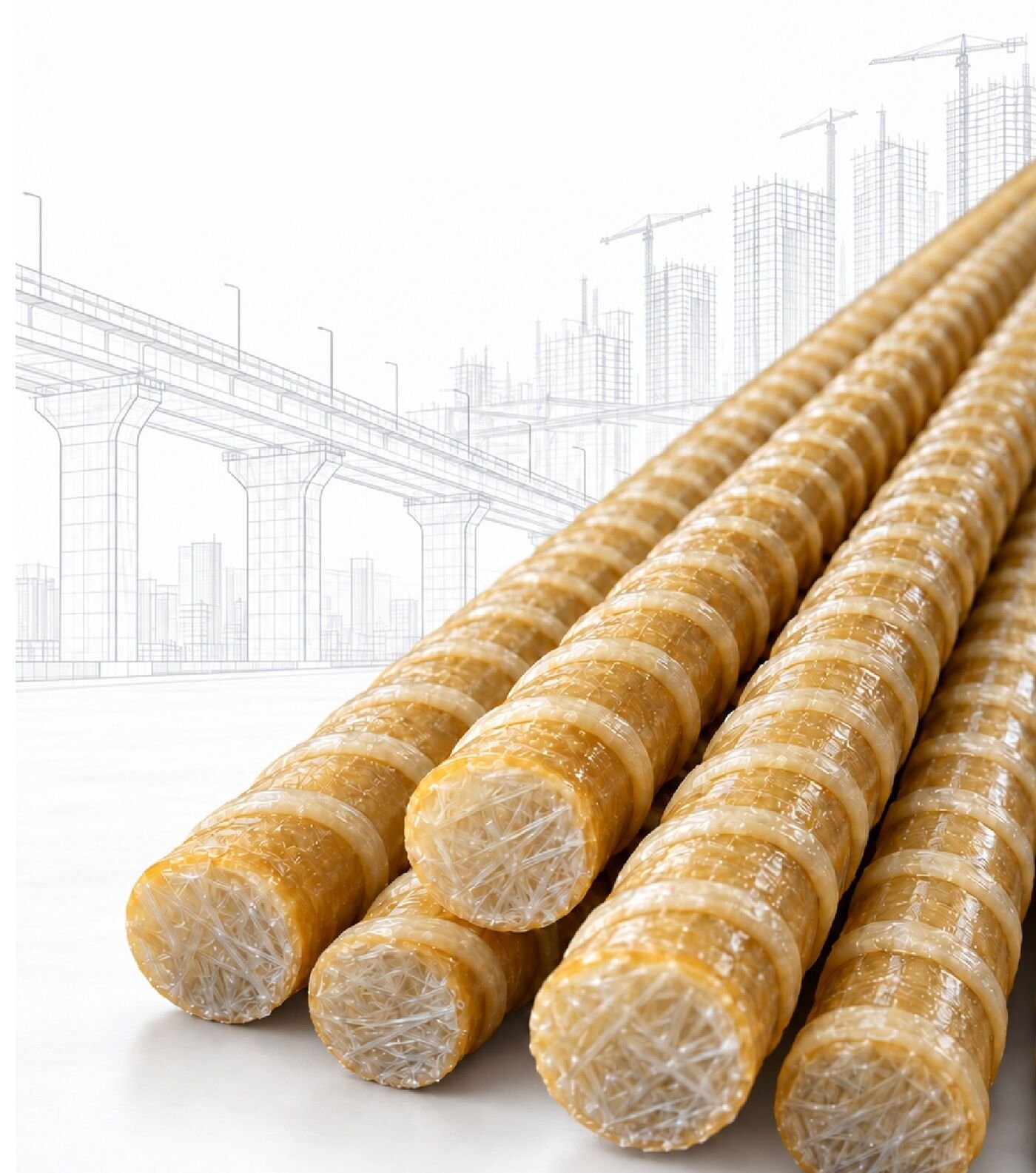
At FIBERONEX, our journey in the field of Glass Fiber Reinforced Polymer (GFRP) reinforcement began in 2021. Since then, we have been focused on understanding the technology, applications, and evolving potential of advanced composite reinforcement solutions for the construction industry.
With a strong interest in innovation and modern construction materials, we aim to contribute to the growing adoption of GFRP rebars across India. We believe the future of infrastructure lies in smarter, durable, and corrosion-resistant reinforcement alternatives.
Our approach is built on technical understanding, product awareness, quality-conscious practices, and a commitment to building lasting relationships with our customers, contractors, engineers, and industry partners.
To become one of India's most trusted and recognized names in GFRP reinforcement by advancing composite technology, strengthening infrastructure solutions, and setting higher benchmarks for quality and reliability.
To deliver dependable GFRP rebar solutions through consistent quality, technical excellence, transparent business practices, and responsive customer support — while building the capabilities to advance towards manufacturing, innovation, and sustainable infrastructure development.
We prioritize quality-conscious practices and dependable products to support the evolving needs of modern construction.
We embrace advanced composite technologies and continuously expand our understanding of GFRP reinforcement to support smarter construction.
We believe in honest communication, responsible business practices, and building trust through transparency and accountability.
We value technical knowledge, product understanding, and continuous learning to help our customers make informed decisions.
We focus on understanding customer requirements, providing dependable support, and building long-term professional relationships.
We contribute to durable infrastructure by promoting suitable advanced reinforcement alternatives and responsible material choices.
We strive to build lasting confidence in Fiberonex through consistency, dependable service, and a long-term commitment to our industry.
Engineered composite reinforcement that solves the problems steel can't — rust, weight, conductivity and maintenance.

| Property | Unit | Fiberonex Rebar | TMT Steel Rebar |
|---|---|---|---|
| Tensile Strength | MPa | 1100> | 415 – 600 |
| Modulus of Elasticity | GPa | 60> | 200 |
| Bond Strength | MPa | 16 | 14 |
| Shear Strength | MPa | 190 | 120 |
| Length | Meter | Up to 100 | 12 |
| Ultimate Strain | % | 1.5 – 2.5 | 0.5 – 0.8 |
| Density | g/cm³ | 1.9 – 2.1 | 7.85 |
| Compression | MPa | 450 | 500 |
| Thermal Conductivity | W/m·K | 0.3 – 0.5 | 45 – 60 |
| Chemical Resistance | – | Excellent | Limited |
| Bond with Concrete | – | Excellent | Excellent |
| Maintenance Requirement | – | Very Low | High |
Pick the steel bar you use today to see its Fiberonex GFRP equivalent.
| Fiberonex GFRP Rebar | Metal Rebar | ||
|---|---|---|---|
| Diameter | Weight (per 12 m bar) |
Diameter | Weight (per 12 m bar) |
Note: Weight of individual bars may vary within an allowable tolerance of ±2%. Substitution must be confirmed by a qualified structural designer.


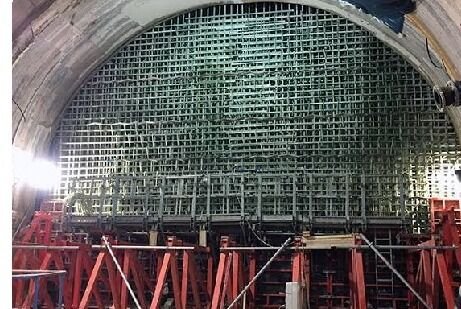
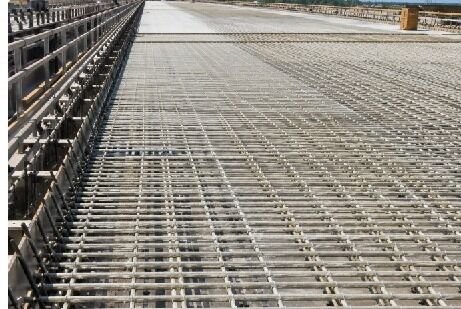
Talk to our team for sizes, pricing and technical guidance.
FIBERONEX GFRP Rebars are non-metallic composite reinforcement bars manufactured using high-strength glass fibres embedded in a polymer resin matrix. Their engineered external surface is designed to develop effective bond with concrete.
Compared with conventional steel reinforcement, GFRP offers several important characteristics, including high corrosion resistance, low density, high tensile strength-to-weight ratio, electrical non-conductivity and non-magnetic behaviour.
GFRP and steel, however, have different mechanical properties. GFRP generally exhibits predominantly linear-elastic behaviour up to failure and has a lower modulus of elasticity than steel. Therefore, GFRP should be designed using its own verified material properties and applicable GFRP design provisions rather than being treated as a direct one-to-one replacement for steel.
Yes. FIBERONEX GFRP Rebars can be used in combination with steel reinforcement where permitted by the structural design and project specifications.
Since GFRP and steel have different stiffness, tensile behaviour, thermal characteristics, durability properties and detailing requirements, the reinforcement arrangement should be determined by a qualified structural designer.
The use of both materials within the same project should therefore be based on the applicable design provisions, structural requirements and verified material properties.
GFRP reinforcement may be considered for appropriate structural applications, but it should not be described universally as being "better than steel" for earthquake-resistant construction.
Seismic structural design involves several parameters, including strength, stiffness, shear capacity, anchorage, confinement, cyclic response, detailing and the required structural performance.
The suitability of FIBERONEX GFRP Rebars for a seismic application should therefore be established through project-specific structural design and the applicable design provisions.
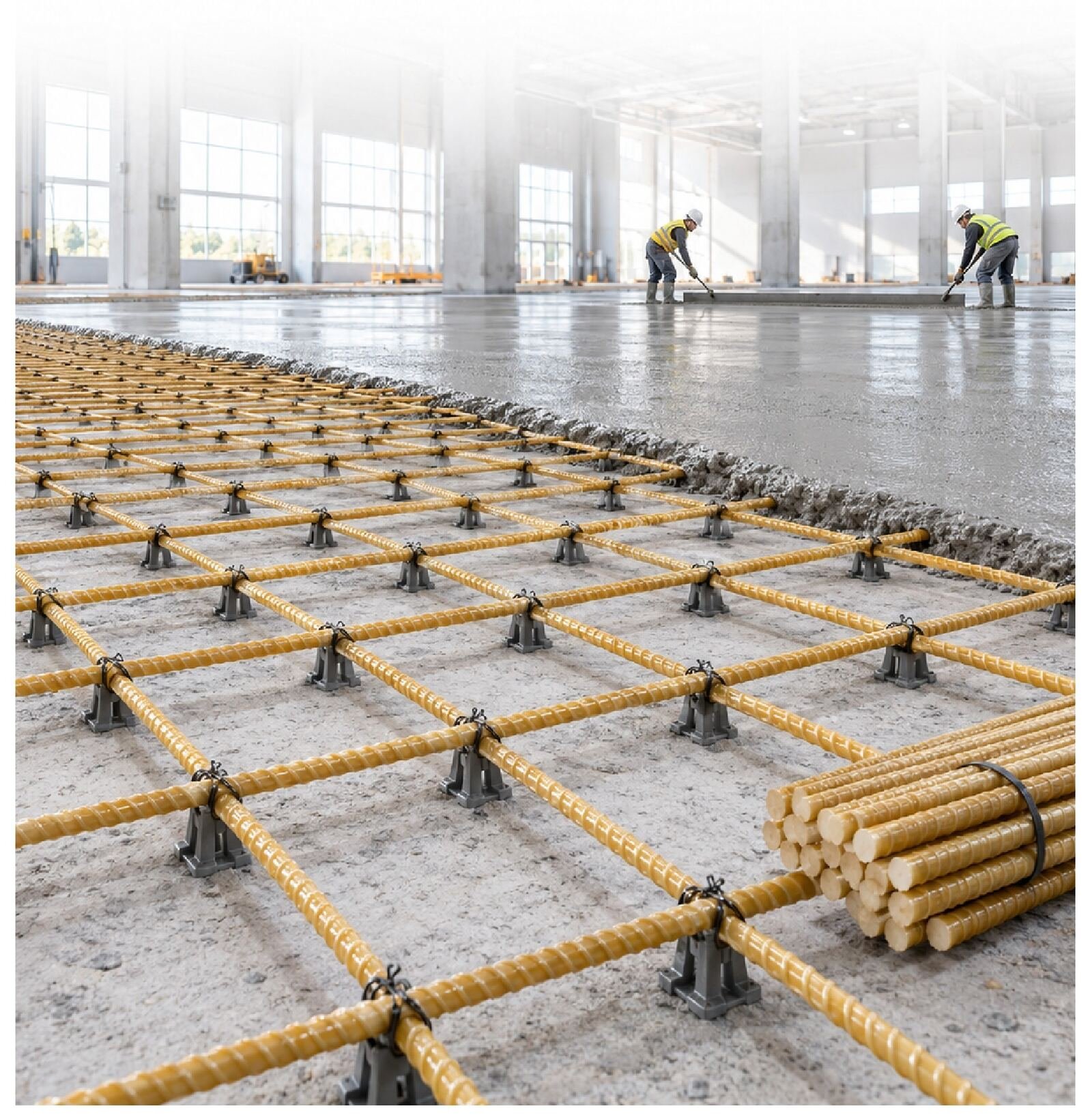
FIBERONEX GFRP Rebars should be securely positioned using suitable tying materials and reinforcement-support systems that do not damage the bar.
Plastic or nylon ties and other suitable non-damaging tying methods may be used where permitted by the project specifications.
The tying system is intended to maintain the correct reinforcement position during concrete placement. It should not damage the bar surface, fibres or engineered surface enhancement.
FIBERONEX therefore positions GFRP as an engineered reinforcement solution, not simply as a steel bar with a different material.
FIBERONEX GFRP Rebars are manufactured with an engineered surface profile intended to provide effective mechanical and interfacial bond with concrete.
Bond performance depends on several factors, including:
For this reason, GFRP bond behaviour should be established through applicable testing and design provisions rather than simply assumed to be identical to steel.
Relevant references: IS 18256:2023; ASTM D7913/D7913M — Bond Strength of FRP Bars to Concrete by Pullout Testing.
GFRP reinforcement should not be considered thermally equivalent to conventional steel reinforcement. Because GFRP contains a polymer resin matrix, elevated temperatures can affect the resin's mechanical contribution and consequently the performance of the reinforcement system.
Fire performance depends on factors such as:
Therefore, FIBERONEX does not recommend assigning one universal "safe temperature" to all GFRP products. Fire-resistance requirements should be evaluated for the specific product and structural system.
Straight FIBERONEX GFRP Rebars should generally not be field-bent like conventional steel reinforcement.
Where hooks, bends, stirrups or other shaped reinforcement are required, these should be manufactured under controlled production conditions according to the specified geometry and applicable requirements.
Unauthorized heating, welding or field bending can adversely affect the reinforcement and should not be performed.
Yes. Temperature can influence the mechanical performance of GFRP reinforcement, particularly at elevated temperatures, because the polymer resin matrix is temperature-sensitive.
The applicable temperature range should be evaluated with consideration of:
FIBERONEX product documentation should therefore state temperature-related performance based on verified product testing rather than using an unsupported universal temperature rating.
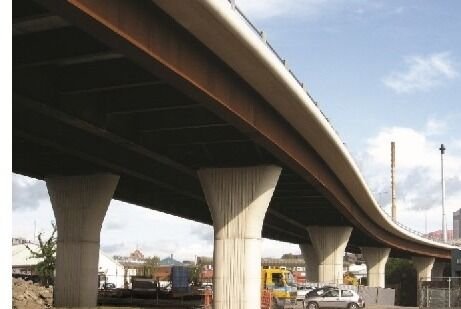
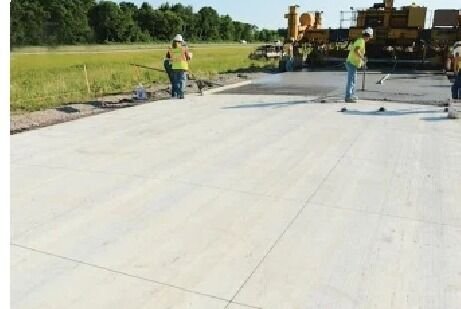
FIBERONEX GFRP Rebars can be used in suitable reinforced-concrete applications where the concrete mix and structural system meet the requirements of the project.
Concrete selection should consider:
The use of GFRP reinforcement does not eliminate the need for proper concrete quality, placement and curing.
For India, IS 18256:2023 specifies the product requirements, while IS 18255:2023 provides test methods for FRP reinforcement. Internationally, ASTM D7957/D7957M is the GFRP bar product specification, with associated ASTM methods for tensile properties, transverse shear, bond, alkali resistance and creep rupture.
Share your project details and our team will get back to you with sizes, pricing and technical support.